Published · Updated
The Price Depends on What Your Key Really Is
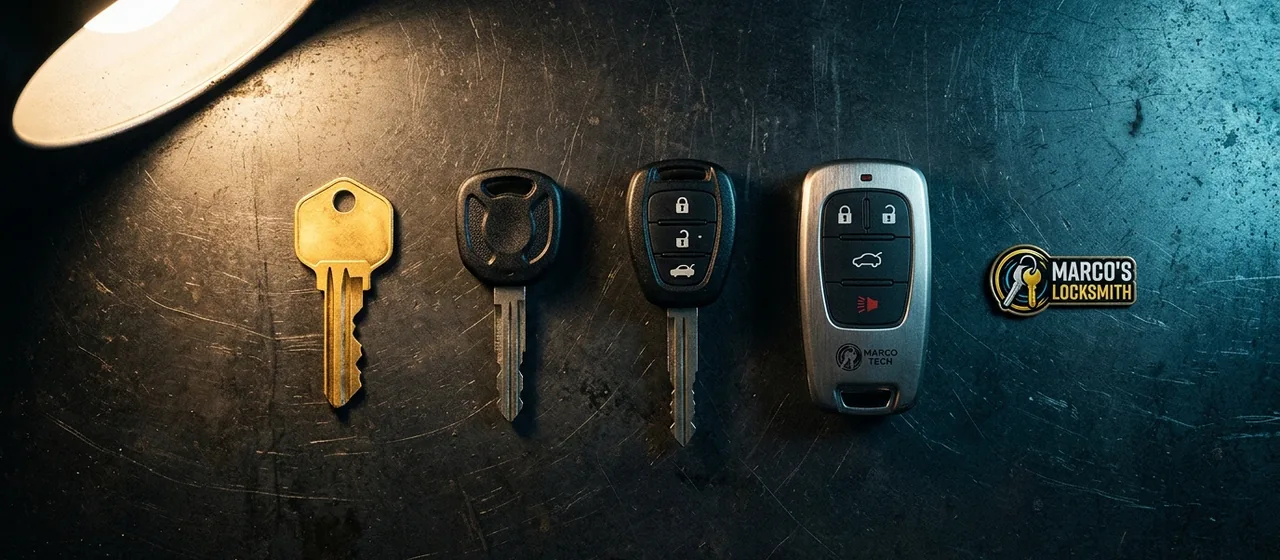
"Car key" covers three very different pieces of technology, and the technology, not the brand of the shop, is the main driver of cost. Here are the complete, all-inclusive ranges we publish, which include the service call, the key or fob itself, cutting, programming, evening-hours timing, fees, and taxes:
| Key type | What it is | Published total |
|---|---|---|
| Standard key | Plain metal, no chip: mostly pre-late-1990s vehicles and some base trims | $90 – $220 |
| Transponder key | Metal key with a chip that must be programmed to the immobilizer | $120 – $260 |
| Smart key / fob | Push-to-start proximity fob, incl. the hidden emergency blade | $180 – $360 |
Ranges are our published all-inclusive totals; your exact number inside the range is confirmed before any work begins and never exceeds the maximum. Not sure which type you have? Read our plain-English key explainer, or go straight to transponder keys and smart keys and fobs.
What You're Actually Paying For
Every published range is built from the same four parts.
- The blank or fob itself. A plain brass blank costs a few dollars; a proximity fob with its circuit board, battery, and emergency blade costs real money before anyone touches it.
- Cutting. Modern keys are often laser-cut (sidewinder) rather than edge-cut, requiring more expensive machines. Cutting "from code" (making a key with no original to copy) is part of what a properly equipped locksmith brings.
- Programming. The chip or fob must be introduced to your car's immobilizer with diagnostic equipment. This is the step the hardware store cannot do, and the reason a perfectly cut copy can still refuse to start the engine. It is also part of what puts a car at the top or the bottom of its range: some models accept a key through the diagnostic port in minutes, others need a security code pulled first or a timed relearn the car itself insists on.
- The visit itself. The van, the equipment on it, and a licensed technician (CA LCO #8320) coming to your location. That's the part that saves you a tow.
Dealer vs. Locksmith, Honestly
Dealers are not villains. For a handful of exotic or very new models they're genuinely the only option, and a good locksmith will say so.
But for the Hondas, Toyotas, Nissans, Fords, and Chevys that fill California driveways, a mobile locksmith does the identical job at your curb, usually same-day, without the tow the dealer visit quietly requires. When comparing quotes, ask the dealer the question we answer up front: what is the complete total, with the key, cutting, programming, and labor included?
The Situations That Change the Math
A few common situations move a job within its range or add a step, and none of them should be a surprise.
- All keys lost: stays within the published range for the key type. We program from scratch at the vehicle. Ownership verification required, which protects you as the owner. Details on the car key replacement page.
- Worn keys: if your key "needs a wiggle," a fresh key cut from the factory code, not a copy of the worn key, restores the original geometry, often before the wear kills your ignition.
- Snapped keys: extraction first, then a code-cut replacement. See broken key extraction.
- Just the battery: sometimes a "dead fob" is a flat coin cell, usually a CR2032 or CR2025 that costs a few dollars anywhere. We'll tell you when that's all it is. A locksmith who sells a programmed replacement fob to someone with a battery problem is running the playbook described in our scam guide.