
Published · Updated
The Four Kinds of "Car Key"
Almost every key on the road falls into one of four types, and the type sets the price.
- Plain metal key. Pure mechanics: the cuts match the lock, nothing else happens. Mostly pre-late-1990s vehicles and some base trims. Any decent machine can copy one; replacements are the cheapest tier ($90–$220 published, cut from code with no original needed).
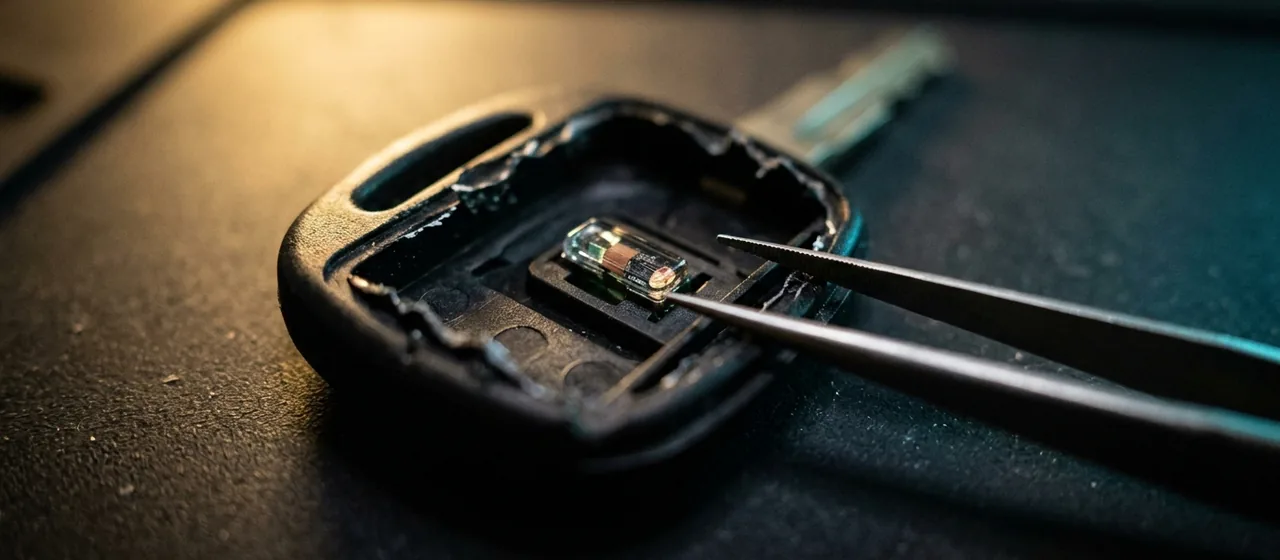
- Transponder key. Looks like a normal key, but the plastic head hides a chip. When you turn the ignition, the car's immobilizer challenges the chip; no valid answer, no engine, even with a perfectly cut blade. This is most keys from the late 90s onward. Replacement means cutting and programming: $120–$260 published, all-inclusive.
- Remote head key. A transponder key with lock/unlock buttons built into the head: two systems in one shell (the chip for starting, the remote for convenience), which is why a dead remote can coexist with a working start, and vice versa.
- Smart key / proximity fob. Push-to-start: the fob talks to the car by radio from your pocket, and a hidden emergency blade covers dead-battery days. The most convenient and the most expensive to replace: $180–$360 published, fob included. Full details on the smart key page.
What the Immobilizer Actually Does
The immobilizer is an anti-theft system with a simple rule: the engine runs only for keys it has been introduced to.
"Programming" is that introduction: done with diagnostic equipment connected to the vehicle, pairing the specific chip in your hand to the specific car in front of it. It's why key cloning at a kiosk hits a wall, why a used fob from the internet may be permanently married to its old car, and why "cut and program" is one job with two halves. It's also, credit where due, a big part of why modern cars are dramatically harder to steal with a screwdriver.
Common Confusions, Sorted
Four things we hear on the phone every week, each with the short explanation.
- "The copy opens the door but won't start the car." Textbook missing-chip symptom: doors are mechanical, engines are electronic.
- "My key has no buttons, so it has no chip." Not necessarily. Plenty of chipped keys look completely plain. The year/make/model settles it.
- "The fob is dead so I'm locked out of starting it." Push-to-start cars have a fallback: a blade for the door and a documented dead-fob starting procedure (often holding the fob against the start button or a marked spot). Your owner's manual knows; so do we.
- "Only the dealer can make my key." True for a handful of exotic and very new models, and we say so when it is. For the mainstream fleet, mobile equipment does the identical pairing at your curb, without the tow.
All Keys Lost: The Scenario That Sorts Locksmiths
Losing every key used to mean a tow and a long dealer wait.
A properly equipped locksmith originates keys at the vehicle, cutting from the factory code and programming from scratch, with ownership verified first, since the same capability in the wrong hands is theft. It stays inside the published range for your key type; details on car key replacement. And if the key didn't vanish but snapped, don't touch glue. Read broken key extraction first.